Fictional brand: Harbor Line pottery (same universe as the brand kit case).
The job
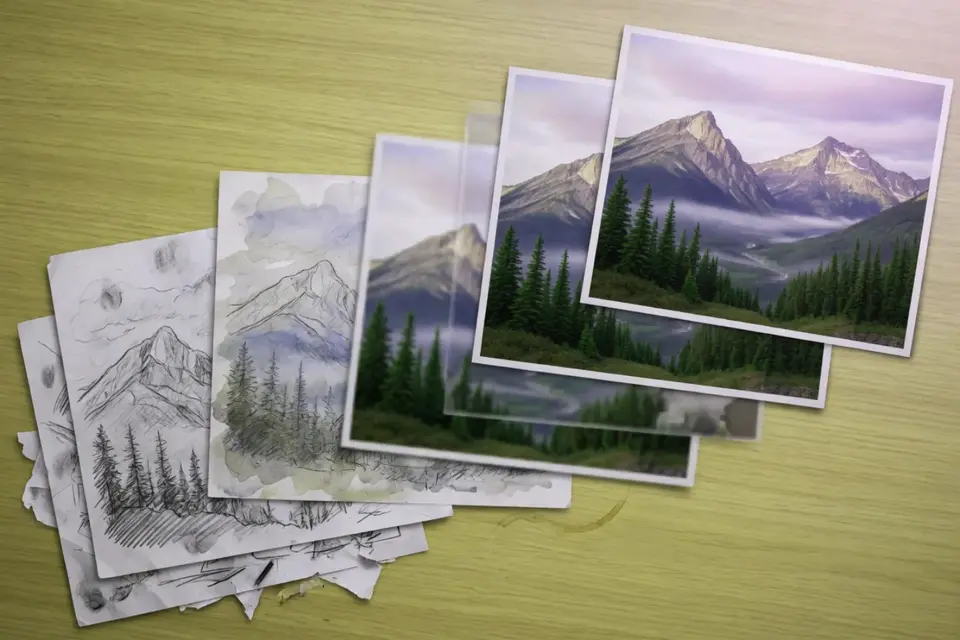
- Length: ~30 seconds
- Goal: emotional product story for web/launch
- Look: calm coastal studio, soft daylight, no comedy jumpscares
- Constraint: product must remain recognizable; no morphing spouts
- Deliverable: storyboard PDF + offline edit with temp music
Success test: founder understands the story from the board alone; motion only enhances approved frames.
Stage 1 — Script beats (writing first)
Using writing for creators:
| Time | Beat |
|---|---|
| 0–4s | Hands open a linen-wrapped cup (anonymous) |
| 4–10s | Slow shelf of finished ware, soft light |
| 10–16s | Hero bowl on oak, steam of tea (subtle) |
| 16–22s | Glaze detail macro, tactile |
| 22–27s | Packing tissue + box close |
| 27–30s | Mark + wordmark end card (real design tool) |
No dialogue. Soft VO optional later.
Stage 2 — Storyboard stills (not video first)
For each beat: one finished still via image pipeline with a shared style paragraph:
soft coastal studio daylight, linen and clay,
muted sea-glass palette, photoreal editorial,
gentle shadows, no logos, no readable stamps
Batch rule: ≤3 candidates per shot; critique for continuity of light direction and palette.
Two kills: shot 3 invented a second brand stamp; shot 5 had neon window color—banned in brand negatives.
Stage 3 — Board review (direction lock)
Founder rules:
- Approve or reject stills before any paid video credits
- Notes must map to shot numbers
- No “make it more cinematic” without specifying which shot
Outcome: shots 1–6 stills approved with “less prop clutter on shelf (shot 2).”
One targeted still regen on shot 2 only—not a full reboard.
Stage 4 — Motion: only where it earns
| Shot | Motion plan | Result |
|---|---|---|
| 1 | Micro push-in | Pass |
| 2 | Slow drift | Pass |
| 3 | Subtle steam + 2% push | Steam overdone once → regen shorter |
| 4 | Macro static + light breath | Pass |
| 5 | Tissue settle | Edge crawl → used static still instead |
| 6 | No AI — designed end card | Pass |
Lesson: static stills beat bad motion. Shot 5 stayed still in the edit.
Image-to-video only, from approved stills (video workflows).
Stage 5 — Edit finish
NLE assembly:
- Stringout of plates/stills to 30s
- J-cuts with soft room tone
- Licensed-or-original bed (not uncleared AI song for this teachable path)
- Simple lower-third only if needed—none here
- End card from vector mark + type in Figma, not model text
- Export web master + 9:16 center crop test
Grade: one shared LUT-ish preset so AI and static sources match.
Continuity log (what kept it coherent)
- Same style paragraph every still
- Same “camera height class” language (eye-level studio)
- Shared avoid list grown via iteration patterns
- Product family limited to two hero forms
Without the log, shot 4 looked like a different short film.
Time and cost sketch (illustrative)
| Phase | Time |
|---|---|
| Script + board brief | 45 min |
| Six stills + critique | 2.5 hr |
| Review + one regen | 30 min |
| Motion attempts | 1.5 hr |
| Edit + sound | 1.5 hr |
| Total | ~6.5–7 hr |
Cheaper than a full crew day; still real work—not a single prompt.
Failures intentionally avoided
| Temptation | Refusal |
|---|---|
| Text-to-video entire film | Brand fidelity risk |
| Twelve-shot epic | Scope creep |
| AI end-card typography | Unreadable marks |
| Regenerating all shots after one note | Discipline |
| Leaving silent | Demo energy |
Audio and VO decisions
We considered AI voiceover and rejected it for this concept. A soft instrumental bed with room tone supported the pottery story without forcing a persona. If VO were required later, the script would be written with writing workflows, recorded with a real mic when brand trust matters, and mixed under the plates—not generated as an afterthought.
Music rights were treated as a first-class checklist item (commercial-use checklist, music workflows). Temp tracks are fine inside the studio; shipping uncleared audio is not.
What we would do differently on v2
- Shoot one real macro glaze plate to anchor tactility if budget allows.
- Pre-visualize 9:16 crops during still approval, not only at export.
- Add a single live-action insert (hands) for hybrid realism (video hybrid notes).
- Build a longer archive: per-shot seeds in a spreadsheet for sequel shorts.
These are production upgrades—not admissions that the pipeline failed.
Reusable production rules from this case
- Board before motion budget.
- Stills carry story; motion is optional seasoning.
- One motion verb per shot.
- Static is an allowed hero.
- End cards are design files.
- Shared grade is non-negotiable.
Print these rules for any 15–45s brand film concept using generative plates.
Checklist template
Related
Published by Tabaconda LLC, Florida, USA. Educational composite—not a client confidential delivery.
Related tools & gear
Useful physical tools for creator tools work. One optional product (see disclosure). Buy only what you need.